Por Tom Williamson |
CRÍTICA URBANA N. 41|

The self-congratulatory narrative favoured by political and business elites frames Manchester’s rebirth from post-industrial decline as a successful model for other cities to follow. Striking skylines and renewed activity in a previously neglected city centre, however, obscure persistent poverty and widening inequality.
The benefits of city centre growth aren’t ‘trickling down’ to most residents nor out into the wider region but are captured as rents through a central development boom. The ‘Manchester Model’ of property-led development sustains itself through gentrification made possible by the privatisation of housing and land and the displacement of communities.
From Cottonopolis to decline
By the mid-19th century, migration from Britain, Ireland and continental Europe had drawn hundreds of thousands to slums surrounding central textile mills. After WWII, bomb damage and the rise of social democracy produced ‘slum clearances’. Council estates were constructed, both surrounding the centre, including on the sites of the cleared slums, and peripheral ‘overspill estates’.
In the 1980s, however, Thatcherism laid the foundations for gentrification. Right to Buy (1980) resulted in the accumulation of ex-council properties in the hands of private landlords. This, combined with demolitions and insufficient construction, has led to social housing shortages. The 1988 Housing Act introduced ‘no-fault’ evictions and effectively abolished rent controls in the private rented sector (PRS). Meanwhile, accelerating deindustrialisation emptied industrial districts and left their workers’ neighbourhoods with high rates of unemployment and poverty.
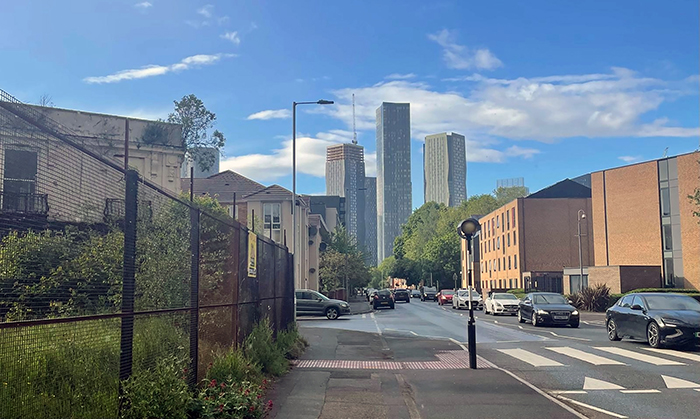
Cluster of residential skyscrapers, as seen from Hulme in 2026. Source: Sara Williamson.
Manc-Hattan
The chosen remedy for this decline has been the Manchester Model of property-led urban development. The local state seeks investment from international financial actors such as private equity funds through subsidies, grants, and weakened ‘affordable’ housing commitments. This has led to the proliferation of high-density residential (particularly ‘build-to-rent’) developments in the urban core spanning parts of Manchester, Salford and Trafford.
Crucial to this has been the creation of skilled jobs attracting higher-income residents. Helped by the commodification of the city-region’s cultural identity and its positioning as the UK’s ‘second city’, this has driven population growth in the formerly underpopulated centre, reinforcing speculative housing investment.
Rent gaps
The ‘rent gap’ helps explain this central development boom. A rent gap is the difference between current rental income from land or property and the higher returns possible if it was repurposed. When the gap grows large enough, investment is made to repurpose the property and capture those returns. Former industrial districts generated low rents compared to those from ‘luxury’ apartments, incentivising investment.
This same logic spread outward. Deindustrialisation followed by austerity, stagnant wages and increasingly precarious work suppressed rents in inner-city neighbourhoods. Council housing disinvestment brought decay. Yet proximity to the revalorised centre made these areas ‘gentrification frontiers’ as better returns from higher-income tenants incentivised investment. Because these neighbourhoods were dominated by council housing, however, privatisation was necessary to extract higher rents in the deregulated PRS. Right to Buy enabled piecemeal privatisation nationwide, whilst in Manchester the Council has also overseen the privatisation of whole neighbourhoods.
Displacement
The drive to close rent gaps displaces lower income communities. Social housing demolitions, PRS evictions and prohibitive rent increases force tenants out. More indirectly, social housing shortages (as the only housing tenure with affordability baked-in) make neighbourhoods inaccessible. These same shortages and PRS deregulation feed private rent inflation. This in turn increases homes’ asset value for landlords, driving house price inflation. To these indirect pressures we can add changes that make one feel unwelcome in one’s own neighbourhood.
Collyhurst
In 2014 Manchester City Council demolished around 600 council homes in Collyhurst, northeast of the city centre, in a case of state-led gentrification. Plans with Hong Kong based developer Far East Consortium (FEC) include only 130 council homes in the area, while the pledge that 20% will be ‘affordable’ housing means rents of up to 80% of the (skyrocketing) market rate.
The demolished homes form part of an area rebranded ‘Victoria North’. This growing trend to rebrand redeveloped areas illuminates a contradiction characteristic of gentrification: culture produced by working-class communities is used to market the city at large, boosting profits from these developments. However, these profits depend on those same communities’ displacement and even the erasure of their histories through neighbourhood rebranding.
Hulme and Moss Side
To the south of the city centre, Hulme and neighbouring Moss Side have seen racialised stigmatisation since the Windrush generation, contributing to suppressed rents. Rising land values are now linked to the nearby ‘Oxford Road Corridor’, home to universities and tech firms.
Hulme’s social housing has repeatedly been demolished and replaced with mixed tenure stock. The area has also been encroached on by purpose-built student accommodation (PBSA), saddling long-term residents with the unstable sense of place that comes with a transient student population.
In Moss Side, an active gentrification frontier, landlords evict lower-income PRS tenants or serve them prohibitive rent increases before converting their homes into houses in multiple occupation (HMOs) marketed to students and young professionals. Social housing shortages mean those threatened with homelessness may be rehoused by the Council in the PRS and outside Greater Manchester, rupturing vital networks.
Langley
Langley, in Middleton, is the largest ‘overspill’ estate constructed by the Council in the post-war period. Six miles north of the city centre, the neighbourhood exhibits a more peripheral form of gentrification; appeal lies less in proximity to the centre than in a suburban lifestyle often marketed to middle-class families.
Despite these superficial differences, the underlying mechanism of privatisation remains. In the early 2000s, New Labour transferred remaining council housing to not-for-profit social landlords. The Riverside Group, after acquiring housing and land in Langley, has sold formerly public land to private developers. Although Langley’s peripheral location allowed for new private developments without mass demolitions of social housing, Right to Buy sales and insufficient construction have resulted in a net loss of social housing stock.
In Langley there is a sense, particularly for younger generations seeking independence, of being ‘crowded out’ by the ever-growing proportion of unaffordable housing.This feeling is reinforced by Riverside’s failure to properly maintain and repair social homes and the privatisation of remaining green spaces.
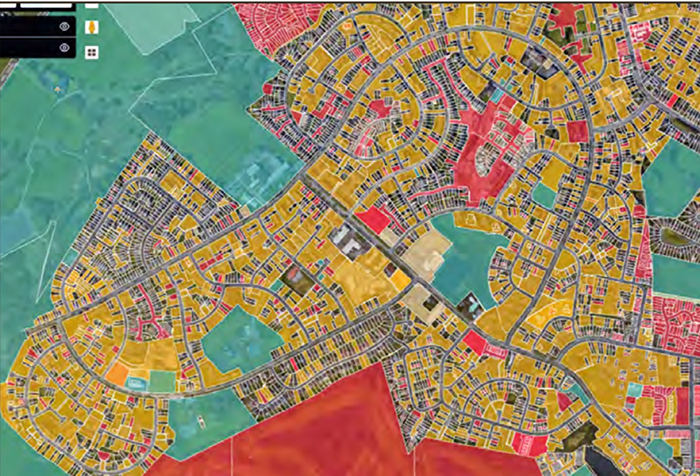
Map of Langley. Public land is green, private land owned by a company is red, and land owned by Riverside is yellow. Source: Who Owns Langley? Land and rent extraction in a Middleton estate, Greater Manchester Tenants Union (via LandInsight), 2025.
Resistance
Collyhurst, FEC Off
In Collyhurst, residents opposing further demolitions under the Victoria North redevelopment organised demonstrations at FEC offices supported by members of the Greater Manchester Tenants Union (GMTU) branch from nearby Harpurhey. At public meetings, members of Rochdale Branch shared tips from their own resistance to demolitions.
Hulme, Block the Block
In Hulme, the Block the Block campaign opposes plans for a nine-storey student accommodation block on public land on the site of a former pub. Despite four planning refusals and legal challenges from residents, the Council repeatedly allowed developers to resubmit proposals.
An alternative community plan- proposed by residents, GMTU, and the architectural cooperative Unit 38- includes social housing, supported housing for older people, and a community centre to help account for the lost pub. GMTU Student Branch has supported the campaign, transgressing false ‘gentrifiers vs locals’ divisions to centre structural forces and demand suitable homes for all.
Langley, The Riverside Campaign
Riverside tenants in Langley were suffering from chronic disrepair that led to the hospitalisation of children. Conversations at the school gates led to tenants organising in GMTU Middleton Branch, from which they launched a campaign including demonstrations at Riverside offices, press exposure, and a survey documenting tenants’ conditions. In collective negotiations, they won repairs and over £90,000 in compensation.
Resistance to displacement first included ‘taking over’ parks not permitting social tenants. Now, having built tenant power fighting disrepair, tenants are targeting control of the estate to combat both disrepair and displacement. To this end, Branch members have pushed community ownership models onto the agenda at an event with the Mayor of Greater Manchester.
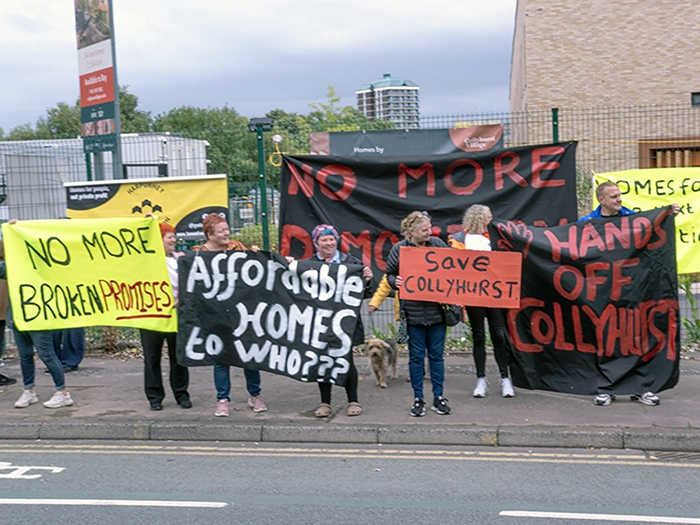
Collyhurst: Hands Off Collyhurst! demonstration. Source: Greater Manchester Tenants Union, 2024.
Reflections
Gentrification is often framed as the unavoidable cost of urban renewal, presenting a false choice between decline and displacement. Backed by the state, this logic has delivered massive urban transformation by encouraging rent-seeking practices and facilitating waves of displacement resembling a form of social cleansing. As peripheral places like Langley become gentrification frontiers, it seems the rentier economy is consuming the city from outside and in.
But this is not the only model. The scale of post-war council housing construction demonstrates that transformative urban development need not depend on speculation. To critique the Manchester Model is not to oppose development itself but to demand a collective right to the city: the right not merely to be consulted, but to shape urban change. As these campaigns show, that begins with collective organising and the building of tenant power.
__________
References
Goulding, R., Leaver, A., & Silver, J. (2025). Centripetal Cities A critique of supply-side urban development. SSRN Electronic Journal.
Smith, N. (1979). Toward a Theory of Gentrification A Back to the City Movement by Capital, not People. Journal of the American Planning Association, 45(4), 538–548.
Williamson et al, 2025. ‘Who Owns Langley: land and rent extraction in a Middleton estate.’ Greater Manchester Tenants Union.
Note on the author
Tom Williamson. Is a sociologist, Greater Manchester Tenants Union (GMTU) member and co-author of Who Owns Langley, about which he has also written in Tribune magazine. He is a researcher now based in Madrid.
Para citar este artículo:
Tom Williamson. The ‘Manchester model’ of displacement. Crítica Urbana. Revista de Estudios Urbanos y Territoriales Vol. 9, núm. 41, Gentrificación. A Coruña: Crítica Urbana, septiembre 2026.
Quizás también te interese