Por Nourhan Bassam |
CRÍTICA URBANA N. 39 |

After fourteen years working as an architect and urban designer, I find myself increasingly reflecting on the gap between terminology and practice. Many of today’s dominant narratives around placemaking & feminist urbanism feel glossy, carefully curated to make consulting firms appear progressive and designers sound inclusive, while leaving existing power structures largely untouched.
In recent years, feminist urbanism has become one of the most celebrated and circulated frameworks within urban design and planning. It appears in policy reports, consultancy decks, conference panels, academic journals, webinars, and online discussions, and perhaps most visibly across social media platforms. The language is inviting, hopeful, and progressive. Words like women, community, participation, care, and safety are repeatedly invoked, often presented as a recipe for more just and inclusive cities.
Including Women Or Redistributing Power?
Yet, at The Gendered City, we have consistently highlighted through our work on feminist placemaking that the growing visibility of feminist language does not automatically translate into feminist practice. Too often, women’s experiences are reduced to stories told on panels, quotes in reports, or short interventions in webinars, visible but contained. Storytelling becomes a form of symbolic inclusion, a kind of urban “magic” “Add Women and Stir” that makes projects appear progressive without fundamentally shifting how power, resources, or decision-making are distributed.
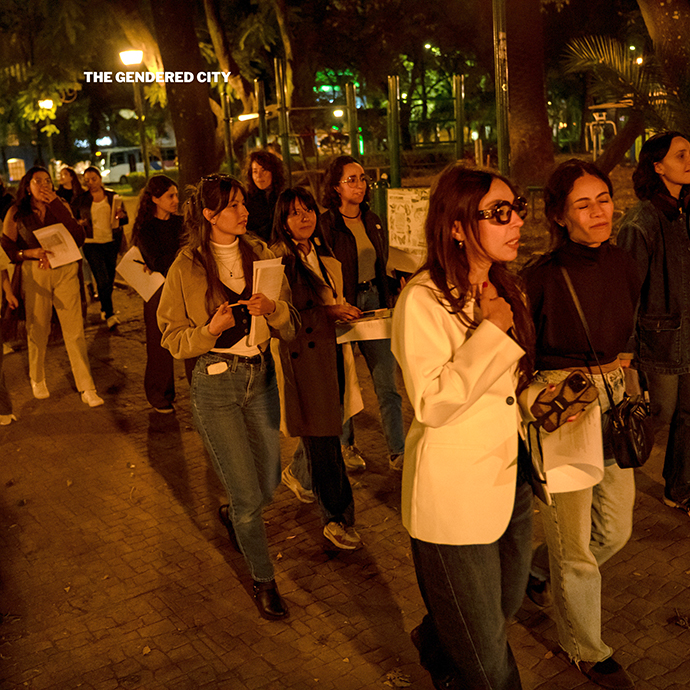
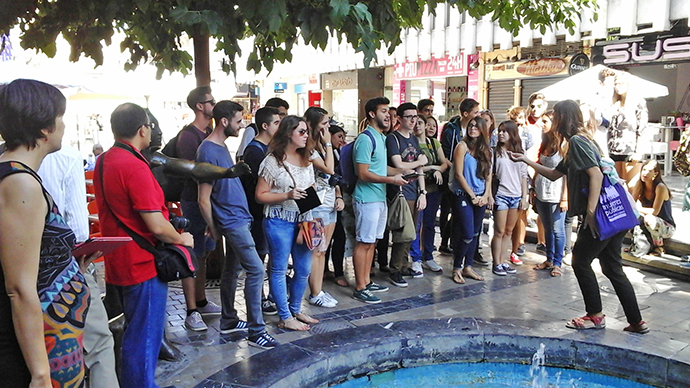
Contextual Feminist Auditing of the Feminist Placemaking Program. Pictures by The Gendered City taken by Mara Artega
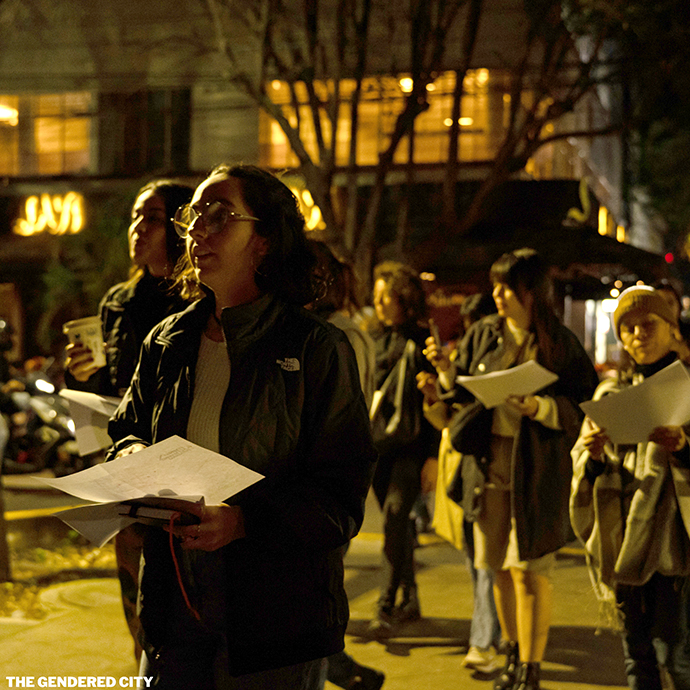
Contextual Feminist Auditing of the Feminist Placemaking Program. Pictures by The Gendered City taken by Mara Artega
When Placemaking Becomes Placefaking.
Placemaking was never meant to be a branding exercise. It is about people shaping the spaces they inhabit. Yet somewhere along the way, participation has been reduced to workshops with predetermined outcomes, sticky notes on walls, and short-term “engagement moments” that check boxes rather than redistribute power.
Women, in particular, are often added to these processes rather than centered within them. Their presence becomes symbolic: a quote in a report, a photograph in a presentation, an invitation to speak on a panel. Visibility replaces agency, and representation stands in for real influence.
At The Gendered City book and in my work, I have been developing frameworks that challenge this superficial inclusion. One of these is Genderfication©, a concept that reframes gender not as an added layer in so-called “gender-sensitive design,” but as a structural force that shapes space, power, access, and value. Genderfication exposes how urban processes often instrumentalize women’s presence while continuing to reproduce exclusionary systems.
Rather than asking how to add gender to design, these frameworks ask how gender already operates within planning, policy, and placemaking, and who benefits from it. This shift moves the conversation away from symbolic participation and toward systemic change.
I have been using Genderfication© as a critical detector for urban development, moving past the aesthetic of inclusion to audit the actual distribution of power and resources. An assessment framework based on this concept distinguishes between Transformative Systemic Change and Tokenistic Outputs.
The Assessment Framework: Systems vs. Symbols
A Genderfication© audit evaluates urban projects by looking at the “invisible” infrastructure of policy, finance, and long-term agency.

Assessing Systemic Change: Three Critical Pillars
To evaluate whether a project is truly dismantling exclusionary systems, the Genderfication© framework’s structural questions:
- The Power Pivot: Who holds the “Mapping Power”?
- The Token: Experts use a gender lens to “study” a neighborhood and then leave.
- The Systemic: The Street Scanner tools are placed in the hands of the community. Systemic change is achieved when the “expert” role shifts from designer to facilitator of local knowledge.
- The Economic Lens: Who reaps the value?
- The Token: Women’s presence is used to “soften” a neighborhood’s image to attract high-end developers (instrumentalization).
- The Systemic: The framework assesses if “Feminist Infrastructures” like social seating and shared kitchens are protected from privatization. It asks: Does this design increase the right to stay, or does it just increase the property value for others?
- The Temporal Dimension: Beyond the “Launch”
- The Token: A project is considered “finished” once the ribbon is cut.
- The Systemic: The presence of Feedback Loops. Systemic change is evidenced by a permanent mechanism where the “Assessing” stage leads back to “Data Gathering,” ensuring the space evolves with the shifting intersections of the community.
Detecting the “Fake”: Red Flags of Tokenism
- Symbolic Representation Only: Street names are changed, but the street itself remains inaccessible to wheelchairs and strollers.
- Safety as Surveillance: Safety is framed as “policing” rather than “belonging” and “social visibility”.
- Gender-Neutral Language: Policies that use “all citizens” to hide the specific, disproportionate burdens placed on women and marginalized bodies.
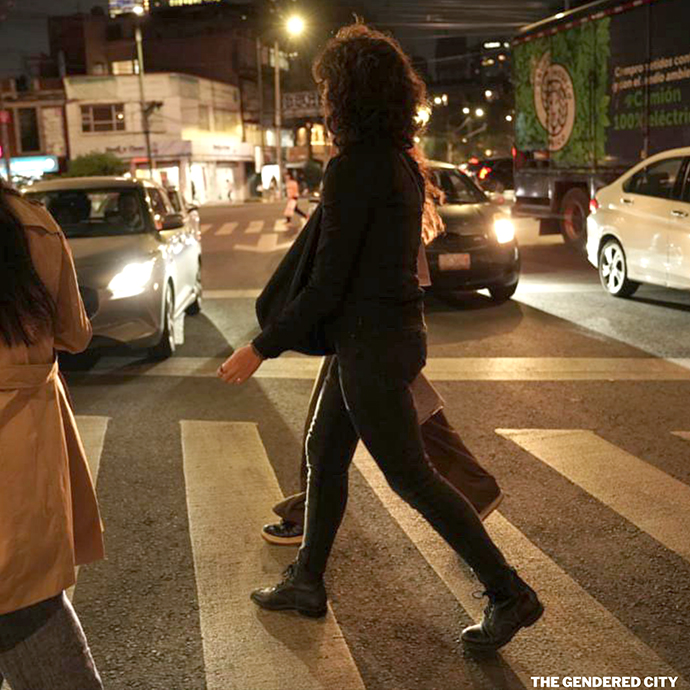
Feminist Night Mapping Walk. Pictures by The Gendered City taken by Mara Artega
From Participation to Co-Creation, and Beyond
Much of our recent work at The Gendered City has focused on understanding how to or not to approach communities. This may sound counterintuitive, but it has become one of the most important lessons I now teach. Knowing how to avoid extractive practices, performative participation, and rushed “co-creation” processes is essential if we want to move beyond shallow engagement.
True co-creation requires time, trust, and a willingness to let go of control. It means accepting uncertainty and resisting the urge to translate lived experience into neat diagrams too quickly. It also means acknowledging that not all knowledge fits into design frameworks, and that this is not a weakness, but a strength.
These questions become even more urgent in times of crisis, whether climate, housing, economic, or political. Crises expose the fragility of our urban systems and the unequal burden carried by women and marginalized communities. Yet they also open space for rethinking priorities: care over efficiency, access over aesthetics, survival over spectacle.
Feminist placemaking, when practiced seriously, offers tools to navigate these moments. It asks us to design not just for women, but with them and to recognize care, safety, mobility, and everyday life as central urban infrastructures.
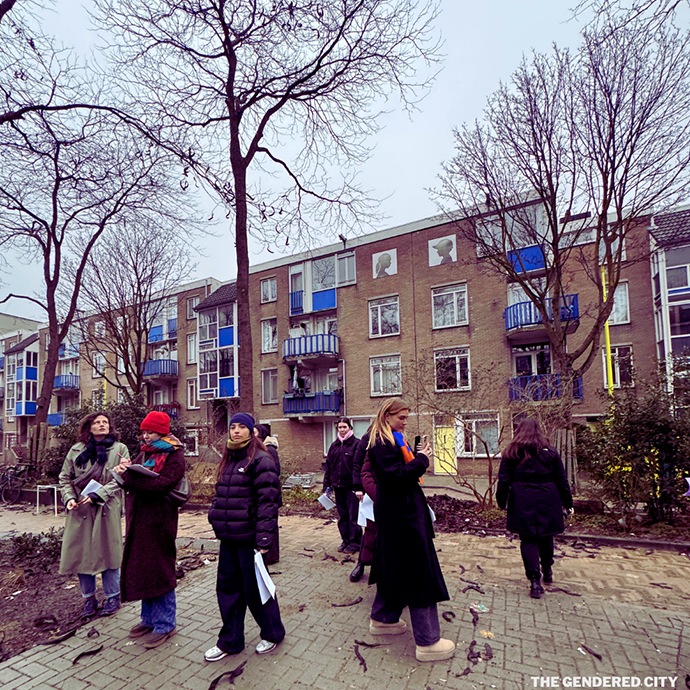
Mapping in Amsterdam. Pictures by The Gendered City.
From Design to Practice
Moving from design to practice means resisting the temptation of catchy slogans and instead committing to long-term, grounded work. It means shifting from asking, “How do we include women?” to “How do we change systems so women no longer need to ask for inclusion?”
Placemaking should not be about making cities look better; it should be about making them fairer. And that requires more than good language. It requires courage, accountability, and a deep respect for the people who already know their cities best.
Nota sobre la autora
Dr. Nourhan Bassam is the first-ever feminist urbanist, architect, and Assistant Professor of Feminist Spatial Design and Theory. Author of The Gendered City and Women After Dark, she is the founder and CEO of The Gendered City, an urban design firm based in Amsterdam and Milan, focusing on design, research, and advocacy to advance feminist urbanism, gender equity and social justice in urban environments.
Para citar este artículo:
Nourhan Bassam. Beyond the Fakes. Crítica Urbana. Revista de Estudios Urbanos y Territoriales Vol. 9, núm. 39, Feminismo y espacio. A Coruña: Crítica Urbana, marzo 2026.
Quizás también te interese